Two or three years ago, I received an email from Chris Brogan asking if I would give some advice to a recent college graduate named Avi Kaplan who was interested in a career of using social media for nonprofits. I chatted with Avi and answered some of his questions. Not long after that, Avi helped Stacey Monk develop a strategy for the very first Tweetsgiving.
A few weeks ago, Avi asked me if I would participate in a blog tour for the Jewels of Elul focused on renewal and beginnings that benefits a residential addiction treatment center in Los Angeles. The Hebrew month of Elul (which started on August 11th), the site will feature reflections from prominent figures on Renewal and Beginnings and a blog tour as well. While I don’t have a strong connection to the nonprofit or even the cause, I know Avi and wanted to support his work. In addition, the theme of new beginnings and renewal has been on mind lately.
This last year has been a year of many new beginnings – a move across the country, a new title, a new book, a new blog, a new company, and new friends and projects. Starting something new is hard for some people. It is a change after all. But with every new project, you always need an end point for reflection.
And that’s the point I want to relate to social media. Whether your begin a new campaign or a new routine, it is important anticipate a point of reflection. We begin a new project – sometimes with to high expectations or excitement. But what we don’t anticipate is the stuff that won’t go perfectly.
When end up avoiding talking about mistakes and we avoid reflection that explores and opens up new breakthroughs because we’re moving too fast into the next action. So, with your next social media beginning, be sure to hit the pause button at the end asks some questions that might lead you to new insights. Here’s a list of questions that my colleague, June Holley, shared with me that I’ve been using.
1.What worked really well in this project?
2.Did it accomplish goals or outcomes? In what ways?
3.Did it fall short? Why?
4.What would you do differently?
5.What surprises came up during the project? What unexpected happened? What could you learn or capture from that?
6.What insights did you get during the project?
7.What processes did you use that worked well? Which didn’t work so well? Why do you think that was?
8.How did people work together? Were there conflicts? How were they handled? Did people get any new insights or perspectives as a result?
9.Were there people or perspectives missing from this project that you would include next time?
10.What skills and processes did you help people learn as part of this project? What skills and processes would you spend time on if you did this over again?
11.What were the most innovative aspects of the project? How did they work?
12.What did you do in this project that you could transfer to other projects?
13.What is the most troubling aspect of the project? What might you do to deal with it differently?
14.What skills came in most handy during this project? What skills did this project make you realize you need to acquire?
15.What really puzzles you about this project? What are unanswered questions you have about what happened?
16.What intrigues you about this project?
17.What would you like to learn more about that would help this (or other projects) in the future?
18.Where did we mess up? Make mistakes? Fall on our face? What can we learn from this?
“This post is part of Jewels of Elul, which celebrates the Jewish tradition to dedicate the 29 days of the
month of Elul to growth and discovery in preparation for the coming high holy days. This year the program is benefiting Beit T’shuvah, a residential addiction treatment center in Los Angeles. You can subscribe on Jewels of Elul to receive inspirational reflections from public figures each day of the month. You don’t have to be on the blog tour to write a blog post on “The Art of Beginning… Again”. We invite everyone to post this month (August 11th – September 8th) with Jewels of Elul to grow and learn.”
Flickr Photo by Metro Transportation Library and Archive
Successful social media is like going to the gym because the discipline of a good routine gets results much like working out on a daily basis.
If you have put on running shoes for the first time, do you think you can really expect to win the Boston Marathon? If you are just starting out or if you haven’t identified a strategy and a good regular routine, can you really expect success? You need to make social media a daily habit; understand the rules, the landscape, and above all give it time to work.
Actionable Measurement
The gym metaphor resonated because lately I’ve been obsessed with the idea of “SpreadSheet Aerobics, an actionable social media measurement strategy that is fit and trim and light on its feet! When I coach nonprofits on tactics and talk about measurement, their facial expressions change happy to annoyed. Collecting data is often viewed as an onerous task. It doesn’t have to be that way.
We know that good practice is to establish SMART objectives for your social media strategy and identify the audience before you executive. You also need to think through your content and engagement strategy. You should also be thinking about what to measure and set up an efficient method for collecting that data. And, of course, making the time to actually look and think about what the data means.
We get so overloaded by meaningless data collection, that we’re exhausted before we get to do the fun part: making sense out of it. I don’t try to measure everything. I find it overwhelming and a lot of it won’t help me refine my strategy. Spreadsheet aerobics is actionable data. What does that mean?
Measurement should inform specific decisions and/or actions.
Do not measure everything, but do measure what is most important to your objectives.
The data you gather should help you learn.
Avoid Measurement As Therapy and Drive By Analysis
Avoid this measurement as therapy trap. When we see the green arrows pointing up and the numbers look good, we might think — “they like me, they really like me.” But you can’t really put that data into context and learn from it.
Here’s my spreadsheet aerobics daily and monthly routine. I grab the monthly daily data from the insights tool (old version) and download into a spreadsheet. Out of the 25 or metrics I could look at, I only collect the following metrics:
Total Interactions
Likes
Comments
New Fans (Likes)
Unsubscribes
Page Views
Photo/video Views (optional if I’m testing as content strategy)
I also have columns in daily spreadsheet for labeled “content format”, “content topic” and “promotion”. In the content line, I put a link to the actual post noting the type, voice, or if it was a fan posting. I also make notes about what promotional tactics I used. Then at the end of the month, allocate a half hour to look at the numbers for the month in comparison to other months – and look for insights and trends.
In reviewing my spreadsheet, I discover what works. For example, open-ended questions work, particularly those that allow people to share their knowledge or ones accompanying a good resource link.
I’ve looked at frequency of posting and day/time of the week, but have learned what my sweet spot is for my audience on Facebook and no longer track it on a regular basis.
It is also important to track exactly how you promote your Facebook page and what helps you recruit more fans. I keep notes on when I’ve tweeted a link, speaking dates, posting updates in my status about my fan page and all the multi-channel ways you need to promote your page.
I’ve also discovered that it is important to identify as many opportunities to set up experiments that you measure and learn as you go. This is where I’ve gleaned most of my insights – a combination of quantitative metrics culled from Insights and what people are saying on the page.
What are you learning from your social media measurement strategy? How have you kept your data collection trim, fit, and actionable? What is the most compelling thing you learned about your social media strategy through measurement that lead to better results?
Based on the discussion threads in my Facebook page, I’ve updated my mega list of tools in my social media listening and engaging instructional wiki. In reflecting over the past three years, the definition of listening tools has broadened beyond “monitoring” or “research” to include several categories: social media engagement management, analytics, influencer identification, and social network analysis.
Here’s a couple of new tools I’ve been exploring:
RowFeeder should be in your spreadsheet aerobics routine. It searches Twitter and Facebook for phrases or hashtags and dumps them into a google doc spreadsheet. Saves a lot of cut and paste time and great for analysis. The basic version is free, but you can add on data like Klout scores for a minimal fee. It’s particularly useful for aggregating hashtags from events or trainings.
NutshellMail: About a month or so ago, Manny Hernandez mentioned this free tool as a social media time saver. It grabs all your “bacn“ from social networks and aggregates into a single email. The sources include Myspace, Facebook, Twitter, and LinkedIn. You need to customize which updates (wall posts, friend requests, Twitter lists, etc.) to make it useful for your needs. I’m testing it with Facebook because it grabs both my personal profile stuff as well as from Facebook pages that I am an administrator of.
You can also customized the delivery time and frequency. That means it can arrive in your email box when you’ve scheduled to work on it. The email that arrives links you to the places you to respond. This seems like a good tool for those starting out and and with small followings. Saves you time logging in and checking or getting separate notices in email from the social network site.
My colleague, Devon Smith, mentioned another tool, Postling, which aggregates your social networks into a single dashboard online and is also free, although it lacks the robust features of paid tools like Spredfast or SmallAct.
Women Who Tech brings together talented and renowned women breaking new ground in technology who use their tech savvy skills to transform the world and inspire change. The summit provides a supportive network for the vibrant and thriving community of women in technology professions by giving women an open platform to share their talents, experiences, and insights. The 3rd annual Women Who Tech TeleSummit will take place on September 15, 2010 from 11AM EDT to 6PM EDT, with over 800 women from across the US and abroad in the non-profit, political and business world and featuring an incredible lineup of thought provoking panels featuring technology change makers.
I’m honored to be included on this “dream team” roster of women (and a few guys including fellow Zoetican, Geoff Livingston) working on the forefront of social change and technological progress, among them: Mary Hodder, Technologist and Founder of of Dabble.com, Author Blogger and CEO of Zoetica Media, author Clay Shirky, Elisa Camahort Page, Co-Founder of BlogHer, Rashmi Sinha, Co-Founder of SlideShare, Connie Reece, Co-Founder of Social Media Club, Amy Sample Ward of NetSquared, Kaliya Hamlin of Shes Geeky, Genevieve Bell of Intel, Heather Harde, CEO of TechCrunch, Irene Au of Google, Lynne D. Johnson of the Advertising Research Foundation and Tara Hunt, author of the Whuffie Factor.
Here’s the list of panels. I’ll be presenting on a panel “Social Media ROI” with Lauren Vargas from Radian 6, with Cheryl Contee as the moderator on Sept. 15th from 2-3 PM EST. Here’s the description.
Social Media ROI
Do you know what kind of an impact social media is having on your brand, mission, or bottom line? How do you put a monetary value on branding? This panel will discuss realistic metrics and benchmarks any organization can use in their campaigns and ensure that your using the right strategies and tools to listen and engage your audiences on different social networks.
Details about how to register and more program details here.
I have two comp tickets to give away. If you’d like a chance at winning those, leave a comment below on why you want to attend. I’ll pick two winners at random.
was the keynote speaker at last week’s Craigslist Foundation Bootcamp and one thing that he said that has been stuck in my head is: “You can have a job, a career, or calling“ The latter, a calling, is when you can tap into an internal motivation that fuels and inspires you. It resonated. I feel that my technology training for nonprofits work is more like a calling for me than simply a job or career. For the past 15 years, I have been excited about nonprofit technology training design and delivery and it is what I will continue to focus on as part of my role at Zoetica over the coming years.
Balancing Learning Through Content Delivery and Sharing Experience
I’ve constantly stretching myself to learn new techniques that help nonprofits embrace and effectively put social media strategies and tools into practice as well as address the change management issues of becoming a Networked Nonprofit. It isn’t about content, although that is important. What I’m most excited about is “networked learning” – it is part peer learning, part content-delivery, and another part engaging people in the room and not in the room in conversation through the use of social media.
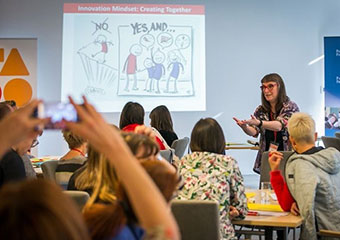
The stretching part for me with this workshop was how to do you design for small group conversations and then full group sharing with 300 people in the room? You offer some ideas, concepts, and good conversation starters. The video above shows the whole room discussing an important Networked Nonprofit concept, simplicity (focus on what you do best and network the rest.)
From Conversational Keynote To Conversational Workshop
A conversational approach is not an expert or a group of experts talking the whole time. Nor is it a 40 minute expert presentation or a series of expert presentations on a panel followed by Q/A. That is the “Sage on the Stage” model. A conversational panel or keynote does some blending of learning modalities – it includes some content-delivery and structured small group and full group conversations. There is a lead facilitator – in the panel or keynote model – it’s the Oprah with the mic.
My design question: What is the best way to use this approach for a full-day workshop for 300 people?
With shorter sessions with half as many people and a decent room layout, you can run the mic yourself. The biggest challenge for me was scaling with mic runners. I had mic runners stationed at different quadrants of the room who would go to the person who wanted to speak. It was hard to get people as engaged as a full group after the table discussions. I’m not sure if this was just the way it is, stage fright to report out to a large group that included funders, or perhaps it needed another method than mic runners (fixed mics stationed around the room?)
Social Media Game: Scaling Small Group Learning Exercises
The Environmental Defense Fund has used the game for an internal training for 300 people. I applied the lessons learned from that to the challenge was scaling this for 300 people from different organizations in a way that helped experience a strategy brainstorm and help them make choices about the tool/tactical sessions later in the day.
When I’ve used this curriculum, I listen to the conversations at the tables to see if people are engaged, stuck, or have questions. It is hard for one person to do that with 300 people and 30 tables, but the experience has given me some great ideas on how to scale that. Also, there is the perennial issue around expertise groupings — the tension between mixed levels and like cohort groups. I’ve experimented both ways and have come to the conclusion that you cannot please everyone.
Refining Real-Time Networked Learning
Real-Time networked learning is incorporating social media into your instruction – before, during, and after. You can learn more from my “Social Media For Trainers” presentations and wiki. Our hashtag #ztrain generated 567 tweets from 126 people -the majority were in the room. The priority was to use social media to enhance the experience of people in the room, although not everyone views using live tweeting as a benefit to the conversational process or learning.
Hashtag Stats
What the Hashtag is a simple tool for aggregating tweets into a transcript and some simple stats, but after experiencing Marc Meyerand Jason Breed’s Hashtag Social Media Chat and their tool that aggregates tweets, I need to do some re-thinking.
The best thing about having a transcript like this it allowed me to do a pattern analysis and learning assessment of the tweets. This will help improve the networked learning design for next time. Some analysis questions:
What points were the participants in the room tweeting? How did that relate to the learning objectives?
Were there conversations taking place between Twitter users that extended the learning or were people mostly parallel online note taking?
Were people not in the room engaged in any of the conversation beyond retweeting?
What Powers Learning: Sharing Experiences and Stories With Peers
I am a big believer that people can learn as much from the peers in the room as the “expert on the stage.” As an instructor, if you go in with the idea that you will be “filling people with knowledge” you don’t let the most valuable form of learning emerge – sharing the wisdom that comes from experience. (The Colorado Funders Association is doing this on its blog about philanthropy stories. ) The fun part of instructional design is embedding opportunities for this to happen.
On this two minute video, Dan Hanley, Director of Development, Boulder County Aids Project, talks about how Twitter is a useful tool in his fundraising work primarily for Twitter’s ability to connect and develop relationships with new donors.
Lisa Harris from Colorado Health Care Foundation and Kindle Morell from Colorado Health Institute shared how they have formed an informal social media peer group of people from different health care organizations in the Denver area. They meet for breakfast and do not have a formal agenda – they discuss areas of practice, including working as change agents inside and outside of their organizations.
The Challenge of Transfer
One-day or half-workshops are only one touch point. They are good for getting a large group of people of to speed. But the real learning comes happens by putting something learned (an idea, a method, a tip, or technique) into daily practice. That is what guided the design of my “Social Media Lab” that continues the peer learning while getting past the challenge of transfer.
That is one reason why I always incorporate a reflection at the end that helps participates identify one small action step. I ask participants to share on an index card as part of a raffle for my book. The information is also valuable for improving the learning design. In addition to the concrete technical and tactical action steps (e.g. set up a listening post), here some additional action steps that indicate the learning from the day will be taken back to others in the organization:
Bring learnings from the day back to my team as soon as possible
Sit down with my executive director to discuss a process for a social media policy
Have a social media strategy brainstorm with staff
Clarifying exactly what we want to accomplish with social media and the audience
Sharing what I learned from my colleagues at the workshop with staff
I can only echo the tweet above: Thank you so much for everything I learned and meeting great people.
Recent Comments